

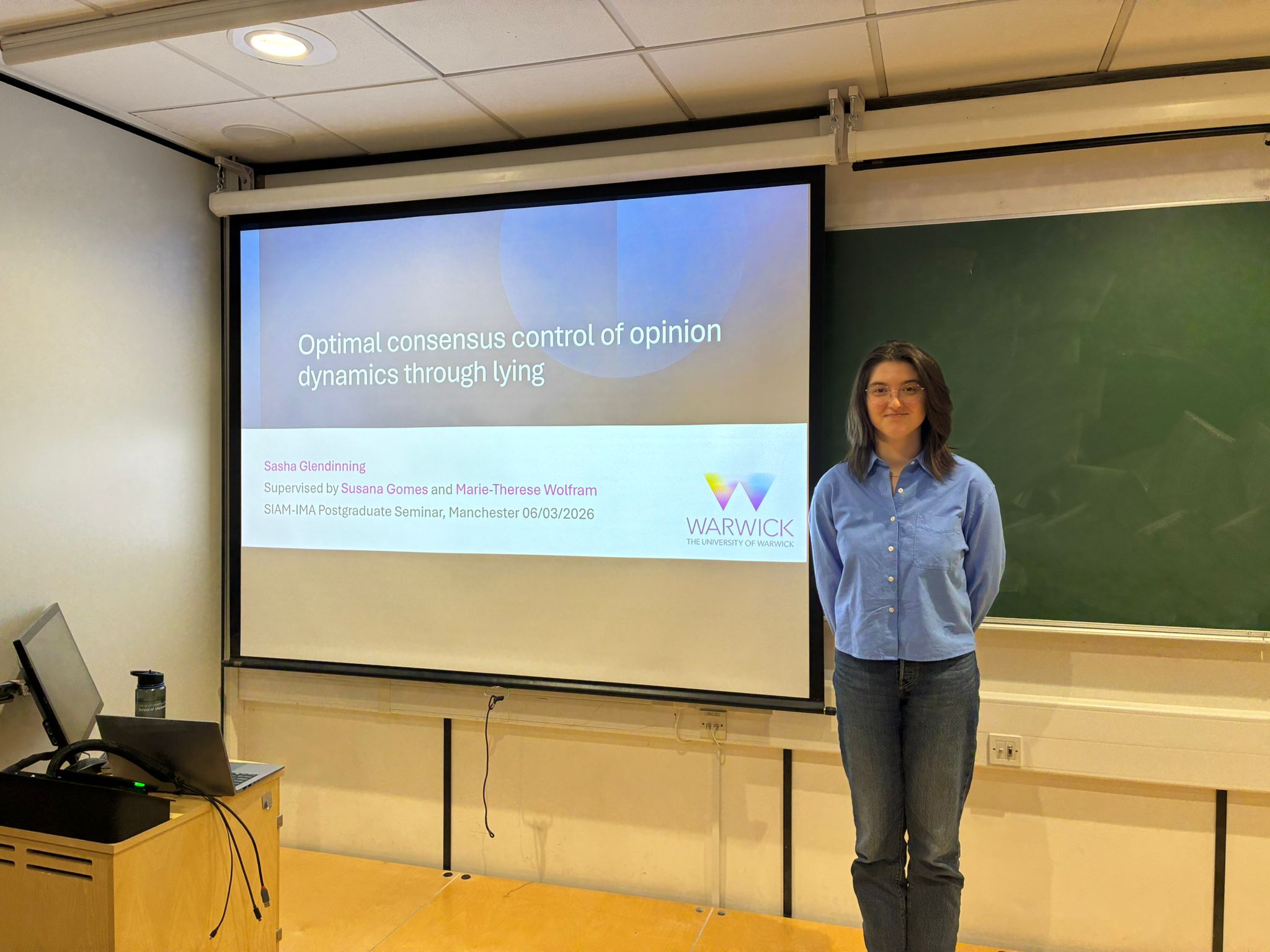
Sasha Glendinning, University of Warwick
The Hegselmann-Krause model of opinion formation involves a system of ODEs with possibly complex interactions driving the evolution of opinions toward consensus or polarisation. We consider a system with one agent who is able to lie - meaning that they can choose what opinion they wish to present to their peers. The liar's aim is to bring the population to consensus at his/her true opinion. We frame this problem in terms of optimal control, adding regularisations that are socially intuitive based on the risks and costs associated with lying. Furthermore, we extend our model to a mean field limit via a Boltzmann-type description, recovering a Fokker-Planck equation from which we can determine steady states in simple cases, perform numeric simulations and consider the case where a population is influenced by multiple liars.